Our Mill is open to the public at R50pp and for groups over 5 we’ll get the wheel turning and grain grinding! In time we’ll have local GMO FREE wheat and maize available for purchase too. If history is your thing then you’ll have lots to see and learn here at Glen Avon as it is an 1820s settler farm.
The history of Glen Avon is that of Robert Hart who was regarded as being the “Father of the 1820 Settlers”. Robert Hart was an 18 year old private in the Argyllshire Highlanders when the regiment disembarked at Cape Town in 1795. The regiment served for a while on the Cape frontier until Britain returned the Cape to Holland where after it returned to Britain.
In 1807, however, Robert Hart, now a married man, returned to the Cape as an officer in Colonel Graham’s newly formed Cape Regiment and was stationed at Grahamstown. Later, he was put in charge of the experimental farm founded by Lord Charles Somerset, the governor of the Cape, and which provided supplies to the army.
In 1825 the farm was closed down and the little town of Somerset East (now KwaNojoli) laid out on its grounds. Many of the original houses still stand in this charming little place.
Hart and his family then settled on farmland adjacent to the town which he was granted in recognition of his services to the government. Here he built a homestead – Glen Avon. Hart, who was a pioneer of Merino sheep farming, farmed sheep, grew fruit, especially citrus, and grain. So successful was grain production in the region that it justified him building a commercial mill for neighboring farmers.
The machinery and equipment was made at Leeds in England, shipped to Algoa Bay, transported by bullock wagon to Glen Avon via the old Zuurberg Pass and assembled on the spot.
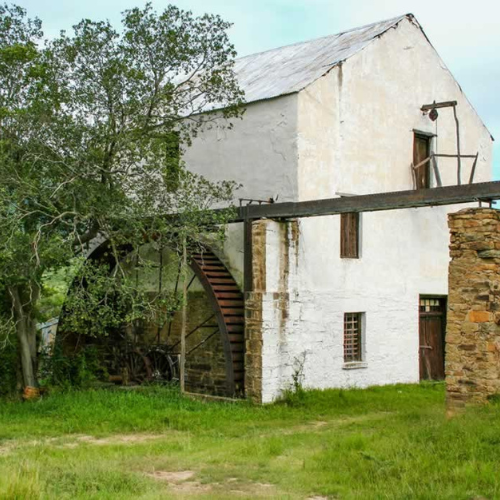
The Water Mill was built by Robert Hart, owner of the farm Glen Avon, Somerset East, between 1822 and 1825. Machinery and equipment was shipped out from England to Port Elizabeth and then transported via the old Zuurberg Pass to Glen Avon, a distance of some 200 km. Here, it was assembled and installed, an incredible feat for those days. Most of the wood used in the construction was sourced off the farm, mainly yellowwood, olivewood and sneezewood. An issue of the Grahamstown Journal of 1826 carries an advertisement for the products of the mill (see Appendix 1).
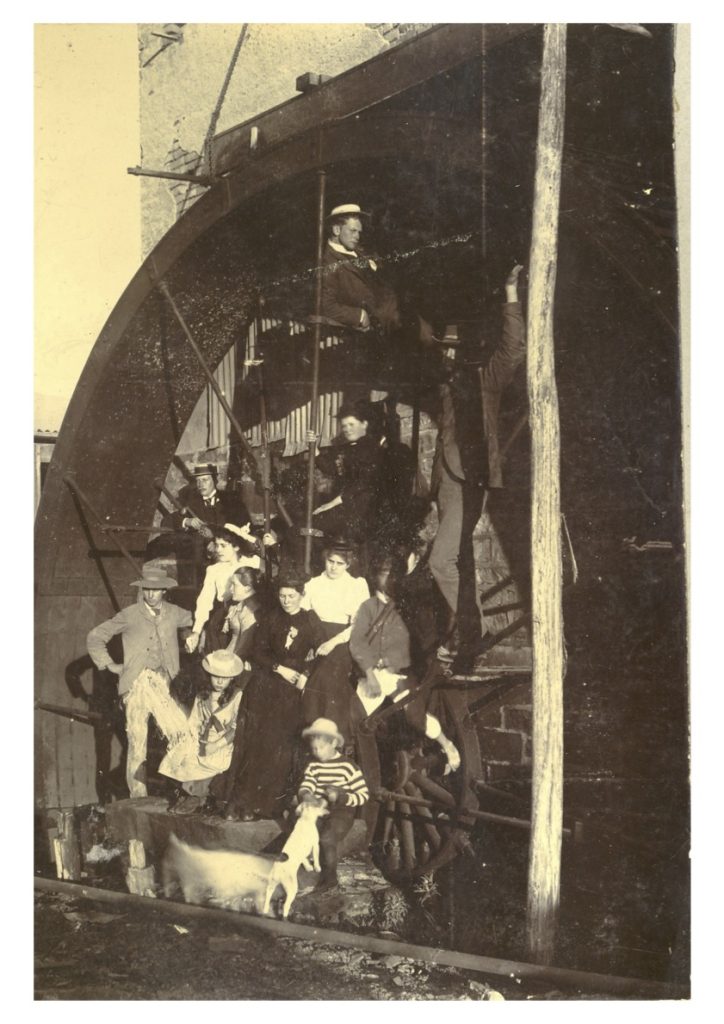
In 1861 a new and bigger iron wheel was installed (30ft in diameter) and is still in fairly good repair. It is presumed that the first and original wheel was a wooden wheel as there are no remnants of it to be found. This mill was still in working order in 1991, though only one grindstone was operational. It worked on average once a month.
When in full working order, the mill operates two grindstones, capacity about 2.25 tons per day. It also has two mealie crushers, a grain crusher for stock feed, two winnowers for cleaning seed and a circular saw and cleaver for firewood.
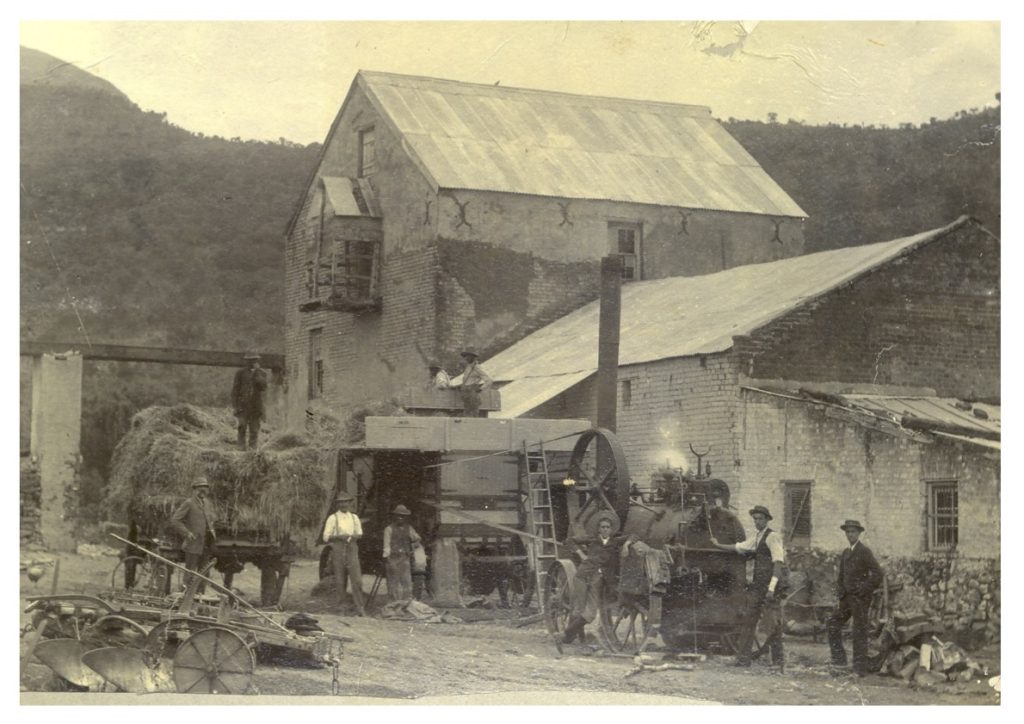
Wagon loads (5 tons) of grain used to be brought in from farms in the surrounding areas – farmers would camp for a day or two, then set off again, delivering meal to farms along their route. Testimony to this can be seen in the ‘graffiti’ on the yellowwood beams inside the mill with dates as far back as 1890.
The mill was repaired in 1982 by the present owner, but by 1991 the steel used in the base of the water chute had rusted through, as can be seen in the accompanying photos (Appendix 2). The entire base of the water chute needs to be replaced.
The Brown family has lived on the farm Glen Avon for eight generations (1817), being direct descendants of Robert Hart. They see that the restoration of the Glen Avon Mill has great potential not only for those immediately associated with the project but also for the whole greater community of Somerset East, and this sadly neglected part of the Eastern Cape.
The Water Mill is certainly one of the best preserved mills in Southern Africa. Its uniqueness and great historical and cultural value cannot be overlooked. In addition the numerous machines associated with and accommodated inside the mill e.g. Maize threshing machinery, winnowers, “New Improved Corn grinder” and wood splitter are all of mechanical and historical significance.